Is some water in the bottom normal?
Often, yes. On GE models without an Ultra Fine filter, GE calls one to two cups of clean water covering the bottom of the tub normal. With an Ultra Fine filter, the water should stay in the filter area and not cover the tub floor. Whirlpool says that on its models with upper and lower filters, a little water in the filter area keeps the seals there from drying out. LG says water below the filter always stays, to trap sewer smells.
On LG, Whirlpool and Bosch models, water standing above the filter is the warning sign. Whirlpool says water slightly above the filter screen often means a partial restriction. Water near the door opening, it says, suggests a severe blockage or a pump that isn't running. There are two harmless exceptions. Bosch lists a program that hasn't ended yet as a cause. LG says a power cut mid-cycle can leave water that drains the next time you run it.
Where's the water? What it usually means
Match what you see to the likely cause, from the manufacturers' own troubleshooting.
| What you see | Likely cause | What to check |
|---|---|---|
| Water just above the filter | A partial restriction in the filter, sump or hose (Whirlpool) | The filter, sump and drain hose |
| Water near the door opening | A severe blockage, or a pump that isn't running (Whirlpool) | The filter and sump, then listen for the pump |
| New dishwasher or disposal, never drained properly | A disposal knockout plug, the dishwasher sitting on its drain hose, or no high loop or air gap (Whirlpool, Samsung) | The knockout plug and the hose route |
| Water spills from the air gap into the sink | A blockage further down the drain (Whirlpool) | The hose below the air gap and the disposal |
| The sink won't drain either | A house plumbing clog, not the dishwasher (Samsung) | Run the sink for about 30 seconds and watch it |
| The pump hums but no water moves | A jammed impeller or a pump obstruction (Whirlpool) | The pump area, with the power off |
| No pump sound at all | Possibly an electrical or control fault (Whirlpool) | A job for a technician |
1. A clogged filter or sump
Before you reach into the tub, switch the dishwasher off at the circuit breaker and let any hot water cool. The checklist further down has the details. Then start with the filter. Whirlpool says many "clogged dishwasher" complaints come from neglected filters or food debris in the sump, the recessed well near the filter.
Bosch says to clean the filter with soap and a soft brush under running water. Whirlpool warns that wire brushes and scouring pads can damage its filters. GE says to use a sponge, since scouring pads or brushes can damage the filter. With the filter out, Whirlpool suggests shining a flashlight into the sump for food, labels, seeds, toothpicks or glass. Bosch says not to let anything fall in.
Put every part back. Samsung says removable parts that are missing or put back incorrectly can cause drain errors. Whirlpool says never to run the dishwasher without its filters. Some GE models have self-cleaning filtration, usually with no removable filter.
2. A kinked or blocked drain hose
GE says to check the drain hose where it connects below the sink for a kink or a blockage. LG warns that heavy things stored under the sink can crush or kink it. After a new installation, Samsung says the most common cause is the dishwasher sitting on top of its own drain hose.
GE says its new dishwashers come with a white corrugated drain hose that should be used. Reusing an old, worn-out hose, GE says, can lead to kinks or a blockage. To clear a blocked hose, Whirlpool says to switch off the power and water, disconnect the hose and flush it with warm water. Avoid sharp tools that could puncture it.
3. The garbage disposal: a clog or a knockout plug
If the dishwasher drains through a garbage disposal, Whirlpool says a clogged disposal can keep it from draining. GE recommends running the disposal before you start the dishwasher.
A newly installed disposal is a classic cause. An InSinkErator installation manual says the disposal's dishwasher inlet is sealed with a plug that must be knocked out before a dishwasher is connected. If it isn't, the dishwasher may overflow. Whirlpool, GE, Samsung and Bosch all say to check for it.
Whirlpool and InSinkErator both describe knocking the plug into the disposal with a screwdriver and pulling it out with pliers. InSinkErator's manual has you do this with the disposal on its side, before it's installed. On a disposal that's already under the sink, you may prefer to leave it to the installer or a technician. If you do it yourself, switch off the disposal's power first and never reach in by hand. InSinkErator says to turn the power off before removing anything from the disposal. GE warns that putting your hands into a disposal could cause serious injury.
If the disposal itself is jammed or won't run, see our garbage disposal repair page.
4. A clogged air gap or a missing high loop
An air gap is the small capped fitting on the sink beside the faucet. To clean it, switch the dishwasher off first, as LG advises. GE says to lift off the cover, unscrew the plastic cap and clean out the debris.
Not every home has an air gap. GE says that without one, the drain hose must have a high loop to drain correctly. The brands give different heights, so follow your model's installation instructions. GE says at least 32 inches above the floor. Whirlpool says at least 20 inches, with an air gap if it's lower. LG says the end of the hose must be 12 to 40 inches above the floor.
5. Suds from the wrong detergent
GE says the wrong type of detergent, or too much of it, can cause oversudsing that keeps the dishwasher from draining. Whirlpool explains why: dishwasher detergent doesn't create suds, but dish soap does. Bosch says dish soap is too foamy and can damage the appliance. LG dishwashers can show a BE (bubble) code for oversudsing. Use only detergent made for dishwashers.
6. A jammed or failed drain pump
Before blaming the pump, clear the debris. Bosch's service information for technicians says many drain pumps are replaced unnecessarily, and that debris in the drain system is the most likely cause. On a Bosch, the pump cover sits under the filter. Bosch says to disconnect the power first, then pry the cover off with a spoon and sponge out the debris and water. Bosch and Samsung both warn that there may be sharp debris, and Bosch mentions glass fragments.
Listen during the drain. Whirlpool says a steady hum with no water moving points to a jammed impeller, and grinding can mean hard debris such as glass. If the pump makes no sound at all, Whirlpool lists the door switch, wiring, pump voltage and the timer or control board. Testing those is a dishwasher repair job.
Drain error codes by brand
Here are the main drain codes, as each manufacturer documents them. Not every model shows every code. OE means a drain fault on an LG but too much water on a Samsung.
| Code | What it means | Start with |
|---|---|---|
| Bosch E24 | Not draining properly | The filter, the drain hose and a new disposal's knockout plug |
| Bosch E25 | A blocked drain pump, or a pump cover that's loose or missing | The pump area under the filter, with the power off |
| GE C1 | Pumping out took more than 2 minutes | Clean the air gap, check the hose and run the disposal; service if it continues |
| GE C3 | The dishwasher will not drain | Switch it off at the breaker for about 30 seconds, then back on; service if it continues |
| GE FTD or F56 | Failure to drain | The drain hose, air gap and disposal |
| Whirlpool F9E1 | Long drain | The filter, hose, disposal and knockout plug, air gap and suds |
| Whirlpool F9E2 | Drain motor error | The knockout plug, disposal and hose; service if the code returns |
| Samsung 5C, SC, 5E or SE | Drain error | The removable parts; after a new installation, the hose under the dishwasher and the disposal cap |
| Samsung OC, 0C or OE | More water than there should be | Samsung's drain and overflow checks |
| LG OE | The tub isn't fully drained | The filter, hose, air gap and knockout plug |
Current Bosch 800 Series and Benchmark models use different drain codes. E:61-02 means a loose pump cover or a blocked pump. E:61-03 means water isn't draining, for example because the disposal is still plugged or the hose is kinked. Bosch's manuals say neither is an appliance error. On current 100, 300 and 500 Series models, Bosch's manuals show drain and water-supply problems as four lights that come on together, not a code.
GE says most of its fault codes need a technician. LG says a code that persists after these checks may mean a faulty part. For more codes, see the Bosch dishwasher codes and GE dishwasher codes on our brand pages.
What you can safely check first
Switch the dishwasher off at the circuit breaker, not just the control panel, and shut the water valve under the sink. If a cycle just ended, let the water cool; LG says to wait 30 minutes before cleaning the filter.
- Bail out the water with a turkey baster or hand pump.
- Clean the filter and check the sump with a flashlight.
- Check the hose under the sink for kinks or crushing.
- Clean the air gap, if you have one.
- Run the disposal, then drain and listen. Turn the dishwasher's power and water back on and run the disposal. Then press Cancel/Drain on a Whirlpool that has it; on an LG, hold Start for at least three seconds (LG notes functions vary by model).
- Frozen pipes? Samsung says to leave the cabinet door under the sink open.
Stop there. Leave the pump cover, the drain hose connections and anything electrical to a technician unless the manufacturer's instructions walk you through them. Never use chemical drain cleaner in a dishwasher, never put your hand into the disposal, and never bypass the door switch.
When to call PowerClean
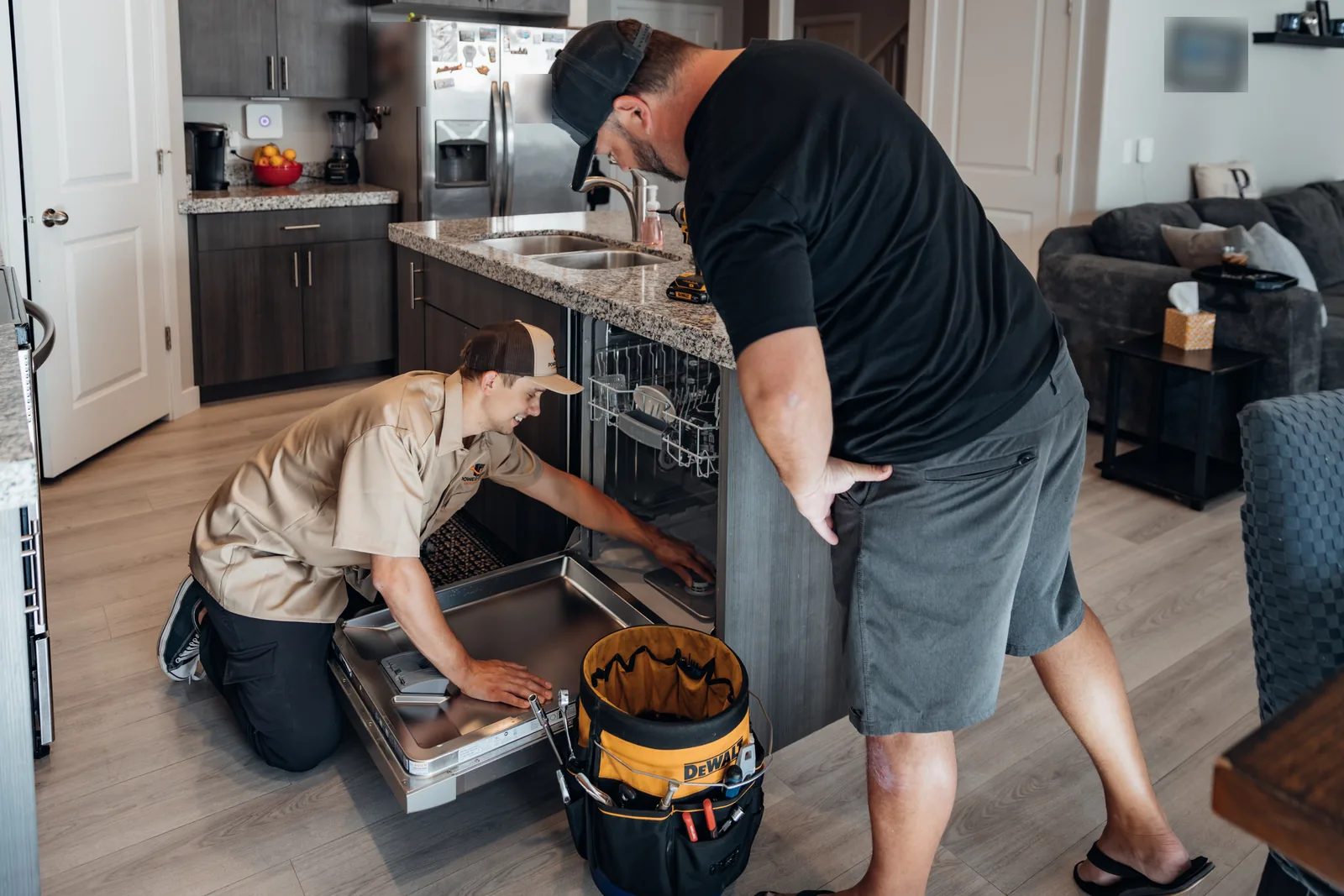
Call us if the drain path is clear and the water still won't go down. The same goes for a pump that hums, grinds or stays silent, or a drain code that keeps coming back. Every repair starts with the $80 diagnostic. Your technician finds what has actually failed and gives you repair options and pricing before any work begins. If you go ahead, the $80 is credited toward the repair. We carry the parts that fail most often, so most repairs finish in one visit. We use OEM parts whenever they're available, and every repair is backed by our 90-day guarantee.
We repair dishwashers across Salt Lake, Davis and Utah counties, the same day whenever possible. See our dishwasher repair page, or the brand pages for Whirlpool, Samsung and LG appliances. Dishes coming out dirty or cloudy instead? See why a dishwasher stops cleaning and what hard water does to appliances in Utah. Call 801-648-8639 or book a repair online.
Still dealing with this? We can usually fix it the same day.