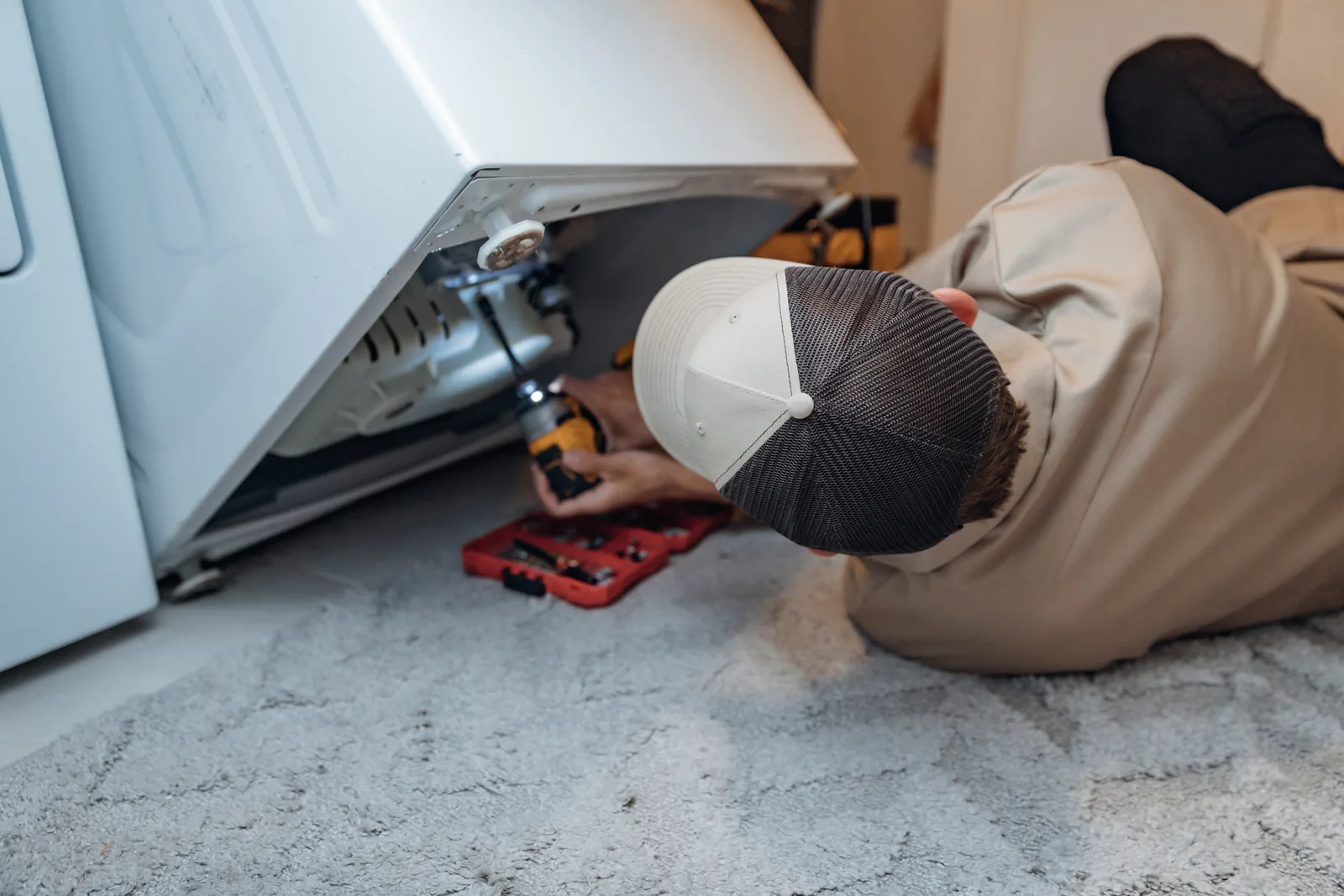
Where the water is, and what it points to
If water has pooled around the washer, switch it off at the breaker first; GE says not to unplug it while standing in water. Once the floor and the area around the cord and outlet are dry, turn the power back on and run an empty rinse and spin (LG's test) or a quick wash with no clothes or detergent (Whirlpool's). Watch where the first drops appear. GE notes that uneven floors can carry water from back to front, or the reverse.
| Where the water is | Likely cause | What to check |
|---|---|---|
| Back, at the hoses | A loose or cross-threaded fill hose, a missing or worn hose washer, a cracked hose or a leaking faucet | Rubber washers in both hose ends, hand-tight, no cracks or bulges |
| In the tub, washer off | A failed water inlet valve | Shut the water valves until it's replaced |
| Back, at the standpipe | A clogged standpipe, or a drain hose that slipped out or is pushed in too far | Pour a pitcher of water into the standpipe quickly; keep the hose secure, not sealed |
| Back, suds at the vent (front-loader) | Too much or non-HE detergent, or residue in the tub | Measured HE detergent, empty cleaning cycles |
| Front, bottom corner | A front-loader's pump filter not seated, or a loose drain hose cap | Filter in fully, not over-tightened; cap on firmly |
| Front, below the door | Dirt, hair or clothing on the door seal, a torn seal or an unlevel washer | Clean the seal and its drain holes, look for tears, level the feet |
| Front, at the drawer | A drawer left open, a clogged dispenser, a pod in the drawer or too much detergent | Close the drawer fully and clean it; Whirlpool says never to put a pod in it |
| Front left, GE top-loader | The overflow tube, usually from oversudsing (GE) | Use less detergent |
| Over the top, top-loader | An overfull load, floating items, a high water level or clothes added mid-cycle | LG: clothes no higher than the top row of drum holes. Whirlpool: at the highest water level, add no more than 1 or 2 small items once it starts. |
| Underneath, middle | The pump, the tub-to-pump hose or the tub seal; on some Whirlpool front-loaders, an open bulk dispenser; on an LG top-loader, residue in the bleach dispenser | Close the bulk dispenser and check the bleach dispenser for residue; the rest is inside the cabinet |
1. Fill hoses and hose washers
Shut the water valves before you check the hoses, as GE advises. Whirlpool says both ends of both hoses need rubber washers and every connection should be tight and not cross-threaded, without over-tightening. GE says a hand-tight connection that still leaks may have a missing or damaged washer or a damaged hose. A leaking faucet, LG says, is likely a faucet problem, not the washer.
Replacing hoses: GE says to change the fill hose screens and washers about every five years. Whirlpool says to replace the fill hoses every five years; its blog says every three to five. LG sets no schedule: replace a hose that turns stiff or shows cracks, tears or bulges. See our washer and dryer maintenance tips.
2. An inlet valve that won't shut off
If water drips into the tub, or the washer fills, while it's off, GE and Whirlpool point to the water inlet valve. GE recommends turning off the water valves on the supply lines; leave them off until the valve is replaced. On an LG, this can show up as an FE code.
3. The drain hose and the standpipe
Water at the standpipe during the drain or spin can mean the house drain isn't keeping up. GE says it often happens about three-quarters of the way through the spin, and that it could indicate a household plumbing problem. LG notes it can look like a washer leak. LG's test: pour a pitcher of water into the standpipe quickly. If it backs up, the drain needs clearing, not the washer.
Whirlpool says the hose should be secure but not sealed, and GE and Samsung warn that a snug or airtight fit can cause siphoning. GE also says a hose pushed too far into the pipe can cause flooding. Follow your installation guide, since each brand gives its own figures:
- Samsung: 6 to 8 inches into the pipe, 18 to 96 inches high, no extension kit.
- GE top-loaders: a drainpipe at least 30 inches high, with 5 to 7 inches of hose inside.
- LG top-loaders: a hose height of about 35 to 47 inches from the floor.
4. The pump filter and drain cap on a front-loader
Some front-loaders have a small access panel on the lower front, with the pump filter and a short drain hose behind it. LG says a leak there means the drain hose cap is loose or the filter isn't seated or screwed on properly. LG recommends cleaning the filter monthly, and Samsung says monthly or every 40 washes, whichever comes first. Screw the filter in fully without over-tightening it, which LG says can damage it. Our Samsung drain code guide shows how to drain the water first.
5. The door seal on a front-loader
Whirlpool says dirt or deposits on the seal or the glass, or clothing caught in the seal, can cause leaks. It also says to check the seal's drain holes after each use. LG suggests cleaning the seal with 3/4 cup of bleach or vinegar per gallon of water. Use one or the other, never both together. LG also warns that straight bleach can make the seal deteriorate. A torn seal has to be replaced, Whirlpool says, and an unlevel washer can leak at the seal.
6. Suds and the detergent drawer
Whirlpool and Samsung say non-HE detergent, or too much of it, makes excess suds that can leak. On a front-loader, they can leak from the rear vent (Whirlpool), which LG ties to residue built up in the tub. On a GE top-loader, GE says water at the front left corner usually comes from the overflow tube. In most cases, GE says, oversudsing is the cause, and it's especially common in homes with a water softener. Our guide to hard water in Utah lists each city's water hardness.
At the drawer, Whirlpool says to close it fully and never put a pod in it. GE says a clogged dispenser backs up and overflows, so clean the trays at least once a month. LG says to dilute fabric softener 50/50 with water.
7. Inside the washer: pump, hose or tub seal
Whirlpool names three parts inside the machine that can leave a puddle underneath: the water pump, a cracked or loose drain hose between the tub and the pump, and the tub seal. Whirlpool says all three may need a technician. GE says oil on the floor under one of its top-loaders comes from the transmission, which must be replaced.
Leak and overflow codes, and look-alikes
Each code's meaning comes from the maker's US support pages. The same letters mean different things on different brands, so read the line for your brand.
| Code | What it means | What to do |
|---|---|---|
| LE or LC | Samsung: a water level or leakage error | Look for a leak and for kinked hoses, and run empty cycles if there are suds. If the code stays and there are no suds, it needs service. |
| OE or OC | Samsung: overflow, too much water | Samsung links a separate overflow guide from its code list; follow it. If the washer also fills while it's off, shut the water valves (see cause 2). |
| 4C | Samsung: not filling, not a leak. Removing the drain hose holder can trigger it. | Hoses on the right inlets, valves fully open, the holder left in place. |
| SUD, E33 or F33 | Samsung, LG, Whirlpool (SUD): too many suds. Bosch washers (E33 or F33): detergent foam. | Measure the detergent and use less; Samsung and Whirlpool call for HE detergent. Samsung says SUD doesn't mean service is needed. |
| FE | LG: overfill. LG says a faulty inlet valve may cause it. GE (electronic washers from 2017 on): water has reached a critical level. | LG front-loaders: unplug for 60 seconds, then run Quick 30. If FE returns, it needs service. GE: turn off the water and power, then call for service. |
| AE | LG front-loaders: a leak inside. LG top-loaders: a gear error, not a leak. | Front-loaders: check the inlet hose for loose connections or cuts. |
| F8E3 | Whirlpool front-loaders: overflow, too much water or foam | Measure HE detergent, skip "no splash" bleach and run a Clean Washer cycle. |
| LO FL or F8E1 | Whirlpool: a long fill, not a leak | Open both faucets fully. |
| E23, F23 or E:00 -23 | Bosch washers: E23 or F23 means the AquaStop hose's leak protection has activated. E:00 -23 means water in the base, or the washer is leaking. | Turn off the water supply right away and stop using the washer. Bosch says to contact its customer support. |
On an LG, LE is a motor code, not a leak, and on a Bosch dishwasher, E23 is a drain pump code. For other faults, see our Samsung, LG, Whirlpool, GE and Bosch repair pages.
What you can safely check first
Before you touch a hose or the pump filter, turn the washer off and unplug it. If water has pooled around it, switch it off at the breaker instead; GE says not to unplug it while standing in water. Shut the water valves, keep a bucket for water left in the hoses, and let hot water cool before you open the pump filter. Turn the power and water back on only for a test cycle, and stay out of any standing water. Then check each spot in the table above, and make sure the washer doesn't rock.
Stop there if the tub fills while the washer is off, water still comes from under the middle, the seal is torn, there's oil on the floor or a leak code keeps coming back. Leave the water valves off, don't take panels off, and never force a locked door or bypass a door or lid switch.
When to call PowerClean
Call us if the leak survives those checks, or right away if the washer fills while it's off.
Every repair starts with the $80 diagnostic: Blake or Jake finds the source and gives you repair options and pricing before any work. The $80 is credited toward the repair if you go ahead. We use OEM parts whenever they're available and carry the parts that fail most often, so most repairs finish in one visit. Our 90-day guarantee backs every repair: if the same problem comes back, we'll make it right.
PowerClean is independent, not affiliated with any appliance brand. We repair washers across Salt Lake, Davis and Utah counties, same day whenever possible. Have the model number handy when you call; here's where to find it. See our washing machine repair page, book online or call 801-648-8639.
Still dealing with this? We can usually fix it the same day.