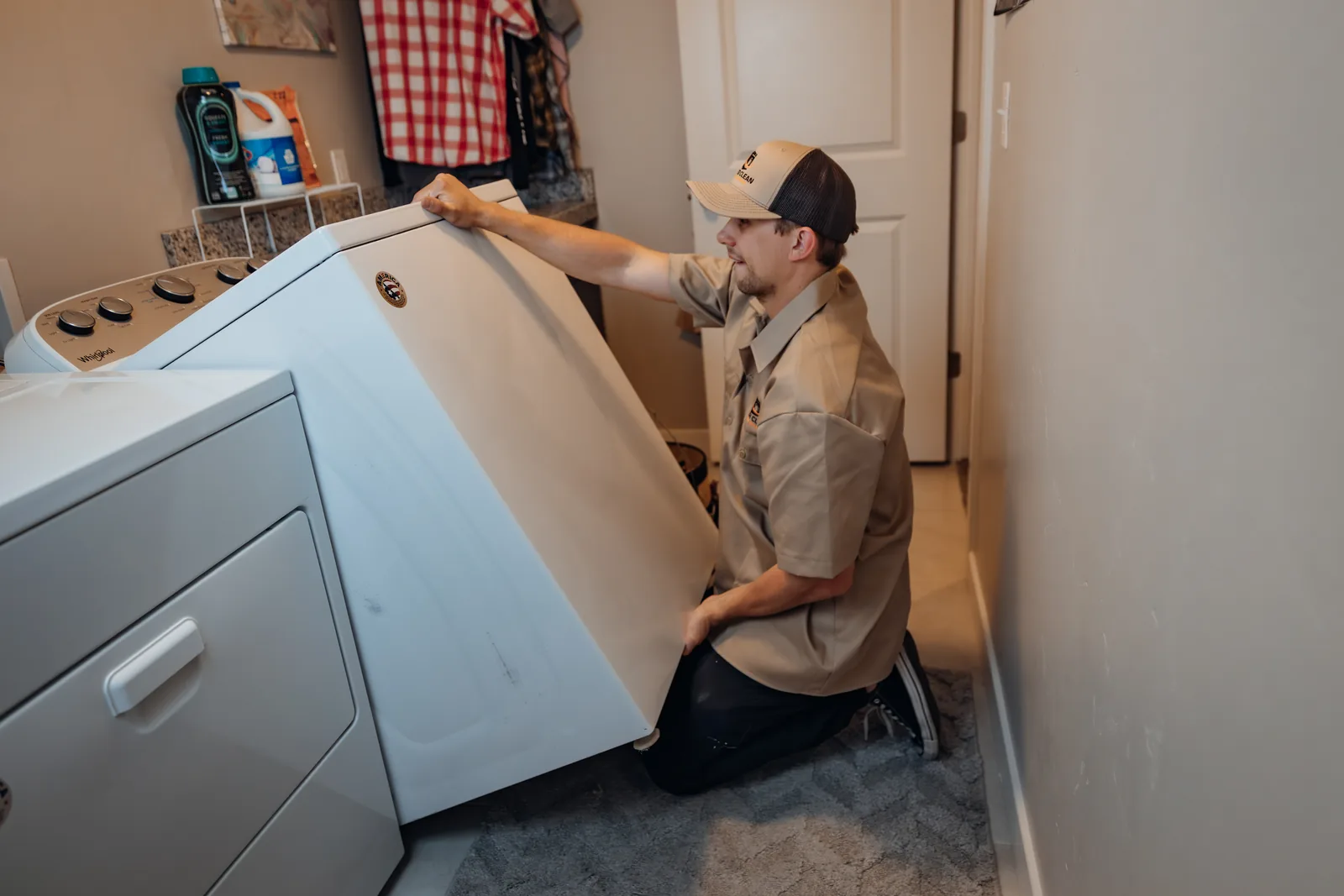
Won't spin, or won't drain? Check this first
If water is standing in the drum after the cycle stops, start with the drain, not the spin. A washer won't spin until the water level drops, so a clogged filter, a kinked hose or a failed drain pump stops the spin too. On some older top-loaders, a failed lid switch or a broken belt stops the pump as well.
On a Samsung washer, a drain fault shows up as a 5C or 5E error code. The won't-drain causes on our washer repair page apply to every brand. If the drum is empty and the clothes are just heavy and wet, it's a spin fault.
1. Lid lock or door lock
A washer won't spin unless it's sure the lid or door is shut. Older top-loaders use a simple lid switch; newer high-efficiency ones latch the lid with a lock before the basket speeds up. A failed switch, a lock that won't engage or a broken lid strike leaves the washer thinking the lid is open, so it skips the spin. The strike is the small piece on the lid that fits into the lock.
On many newer Whirlpool top-load washers, and the Maytag and Amana models built alongside them, the giveaway is a lid lock light that flashes instead of staying on. Front-loaders lock the door at the start of the cycle, so a worn door lock assembly stops the washer from starting or halts it mid-cycle with a door error code.
2. Unbalanced load or an unlevel machine
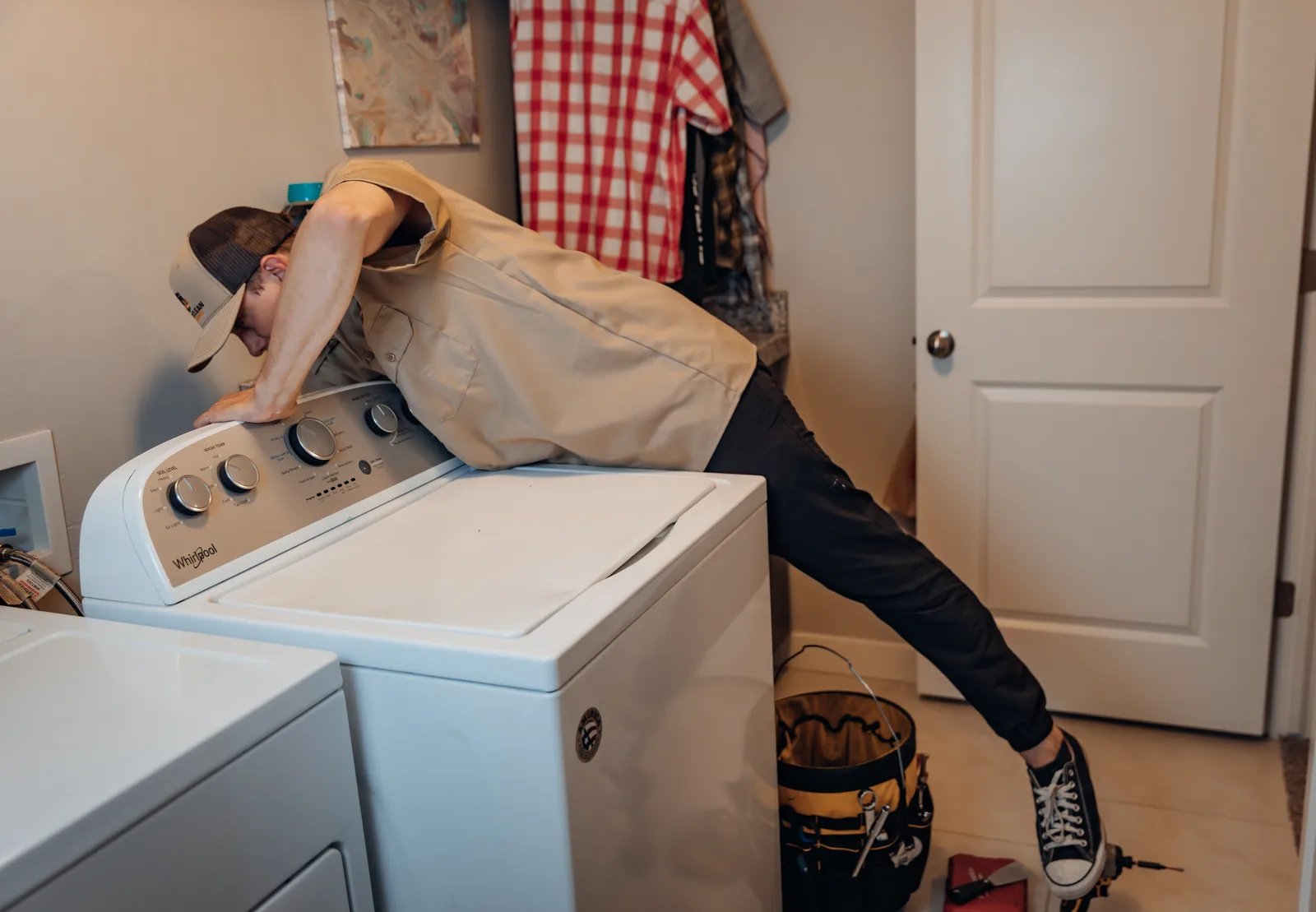
If the load bunches to one side as the spin begins, a modern washer tries to redistribute it, then slows or stops the spin rather than let the tub bang against the cabinet. The clothes come out wet, but nothing is broken.
A single heavy item, such as a bath mat or comforter washed alone, is enough. So is a very small or overstuffed load. LG washers report this as a UE code, and clearing an LG UE error usually starts with the load, not a part.
An unlevel washer rocks as the drum speeds up, with the same result. If the spin cuts out on every load, even balanced ones on a level washer, suspect worn suspension rods (top-loaders) or shock absorbers (front-loaders).
3. Worn or broken drive belt
Many front-loaders and current top-loaders turn the drum, or the transmission under it, with a rubber drive belt. LG's direct-drive washers don't have one. A worn belt stretches and slips under a heavy wet load until it breaks.
Watch for a motor that runs during the spin while the drum sits still or turns slowly, a drum that spins empty but bogs down when loaded, or a burning-rubber smell after a cycle. When we replace a belt, we also check the drum pulley and bearings, since a loose pulley or worn bearing can knock the new belt off.
4. Motor coupling (older direct-drive top-loaders)
Older direct-drive top-loaders built by Whirlpool, including many Kenmore models, have no belt. The motor drives the transmission through a coupling: two plastic drive halves with a rubber cushion between them. It's designed to be the weak link, breaking before a binding transmission or an overloaded drum can damage the motor.
When it fails, the motor runs and the pump usually still drains, but the agitator and drum barely move, if at all. Weak agitation or a grinding rattle often comes first. A new coupling is a straightforward repair, but we also find out why the old one broke. If the transmission is binding, the replacement won't last.
5. Clutch, shift actuator or transmission (top-loaders)
All three sit under the tub, between the motor and the basket.
- Clutch. On many older top-loaders, the clutch slips on purpose as the basket starts to turn, then grips to bring it up to speed. A worn one never fully grips, so the basket spins slowly and the clothes come out dripping, sometimes with a burning smell.
- Shift actuator. Many newer high-efficiency top-loaders use this small motor (also called a shifter) to switch the drive between washing and spinning. When it fails, the washer may fill, wash and drain normally, then hum or sit still when it should spin, often with an error code. It's a common reason these machines won't spin.
- Transmission. This gearbox, or gearcase, turns the agitator and basket, and a worn one grinds loudly. It's the biggest job in this group, and on an older washer it's where the repair-or-replace question starts.
6. Motor, motor control or main board
A hum with nothing moving, or a washer that works one day and quits the next, can point to the electrical side: the drive motor, the motor control board, the drum speed sensor or the main control board. They usually bring an error code, and a motor or board sits at the expensive end of this list. A hum can also mean something mechanical has jammed, so we test the motor and the parts it drives before replacing a board.
If it's a motor or a board, weigh the washer's age. Our rule of thumb: if the repair costs less than half of a comparable new washer and yours is under roughly 8–10 years old, repairing is usually the cheaper and greener choice. When it isn't, we'll say so. Our guide to repairing or replacing a washer or dryer covers the rest.
What you can safely check first
Unplug the washer, or switch it off at the breaker, before you reach into the drum or open the drain filter.
- Get the water out. If the last wash was hot, let the water cool first. Bail a top-loader with a cup and a bucket. Many front-loaders have a drain filter behind a small cover at the bottom front. Put towels and a shallow pan underneath and open it slowly, since more water comes out than the pan holds.
- Redistribute and retry. Spread the clothes evenly, taking a few out if the drum is packed, then plug the washer back in and run a drain-and-spin cycle. If it spins now, the load was the problem.
- Level it. Press down on opposite corners. If it rocks, adjust the foot that's off the floor, then tighten its lock nut.
- Check the lid or door. Close it firmly with nothing caught in it, and look under a top-loader's lid for a cracked or missing strike.
- Listen when it should spin. A hum, a motor running while the drum stays put, or a click and then nothing — each points to different parts, so tell us which you hear when you call.
Stop there. Belts, couplings, clutches and actuators are inside the cabinet. Never tape, wedge or bypass the lid switch to force a spin — it's there so the basket can't spin while a hand is inside.
When to call PowerClean
Call us if the water has drained and a balanced load on a level washer still won't spin. If you smell burning or hear grinding, stop using the washer and call right away. Spin problems also make our list of the five most common washing machine problems.
Our technicians carry the parts that fail most often, so most repairs are finished in one visit, with OEM parts whenever they're available. Every job starts with the $80 diagnostic — we find the actual cause and give you repair options and pricing before any work begins, and the fee is credited toward the repair if you go ahead.
We repair washers across Salt Lake, Utah and Davis counties, same day whenever possible. For leaks, noise and other washer faults, see our washing machine repair page. Call 801-648-8639 or book a repair online.
Still dealing with this? We can usually fix it the same day.